
Finding the 'why' in AI
What happens when we forget the bit in between

Hello lovely reader,
How are you with at-home finger-prick tests? They may be the future of healthcare, but I still go wobbly at the thought of them.
I recently faced my fears when using an app to investigate my heart health. After a hot shower and a stern talking-to, I managed to draw the blood.
The test worked, the process was slick but the result was…unsatisfying.
Not because anything was wrong with the product, but because my results sat somewhere in the middle. Everything is fine for now but one of my totals sits uncomfortably close to the ‘unhealthy’ limit.
As someone highly engaged in my health, I wanted to know what I should do next. The answers weren’t in the app so I needed to look elsewhere.
This is the point at which many of us turn to AI.
With bias baked into many AI tools, and well-documented inaccuracies in women’s health content, this should give us serious pause.
Institutional tools like the NHS app are not helping matters. Regular readers may recall that I recently revisited my ferritin levels after hearing how common iron deficiency is among women. My levels have increased but I suspect they could be higher. The link provided in the NHS app leads to dense, over-complicated pages that explain the number, but not what to do next.
We’ve confused transparency with explanation.
Digital health currently works well for binaries: ‘healthy’ or ‘not healthy’. But many of us live in the in-between, especially when the datasets used for comparison rarely account for sex differences.
The same gap shows up in another area of digital health many women now rely on: cycle tracking.
Many of us now know exactly when our periods are due and can log pain, mood and symptoms with ease. But the questions we really have go unanswered.
Why do my boobs ache some months and not others?
Did that stressful week affect my cycle length?
Are these patterns connected?
Again, the data is collected, but the meaning is missing.
AI answers the question: “What does this mean for me?”
Whether it should or not.
It’s why we end up seeking answers in chatbots, social media and unauthorised experts.
Not because we are careless or uneducated, but because they are often the only places offering context around prevention, ‘nearly high’ results and how different data points connect.
So what’s my advice to the NHS app makers and all digital health developers?
Explain results in plain language
Be honest about uncertainty
Talk about prevention, not just pathology
A final note for founders: build for the in-between. Designing for prevention and uncertainty is not just better care, it also makes your tools more credible partners for the NHS.
Take the why back from AI.

Finding the ‘why’ research gaps this week
Thankfully there are lots of studies happening to help us better understand the bits in between.
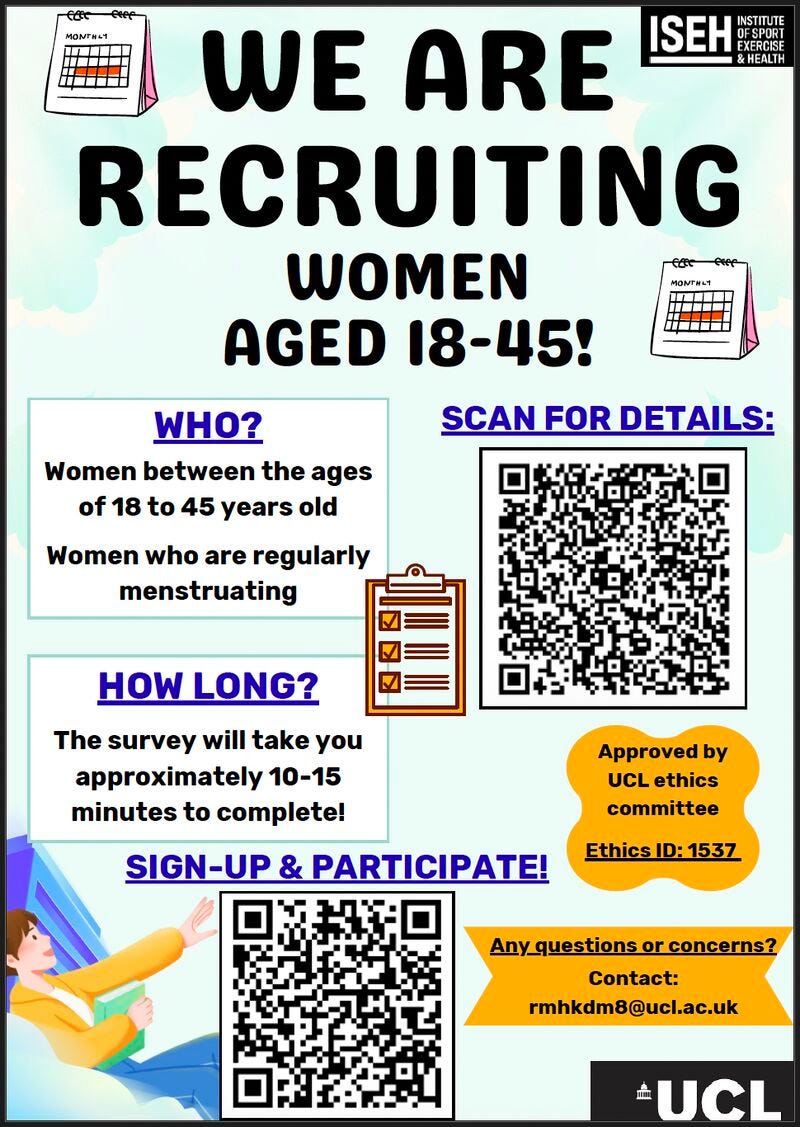
Researchers at University College London are looking at the role of passive exercise on the relief of menstrual cycle symptoms. This one is open to pretty much everyone that has a period. More on the poster below or here.
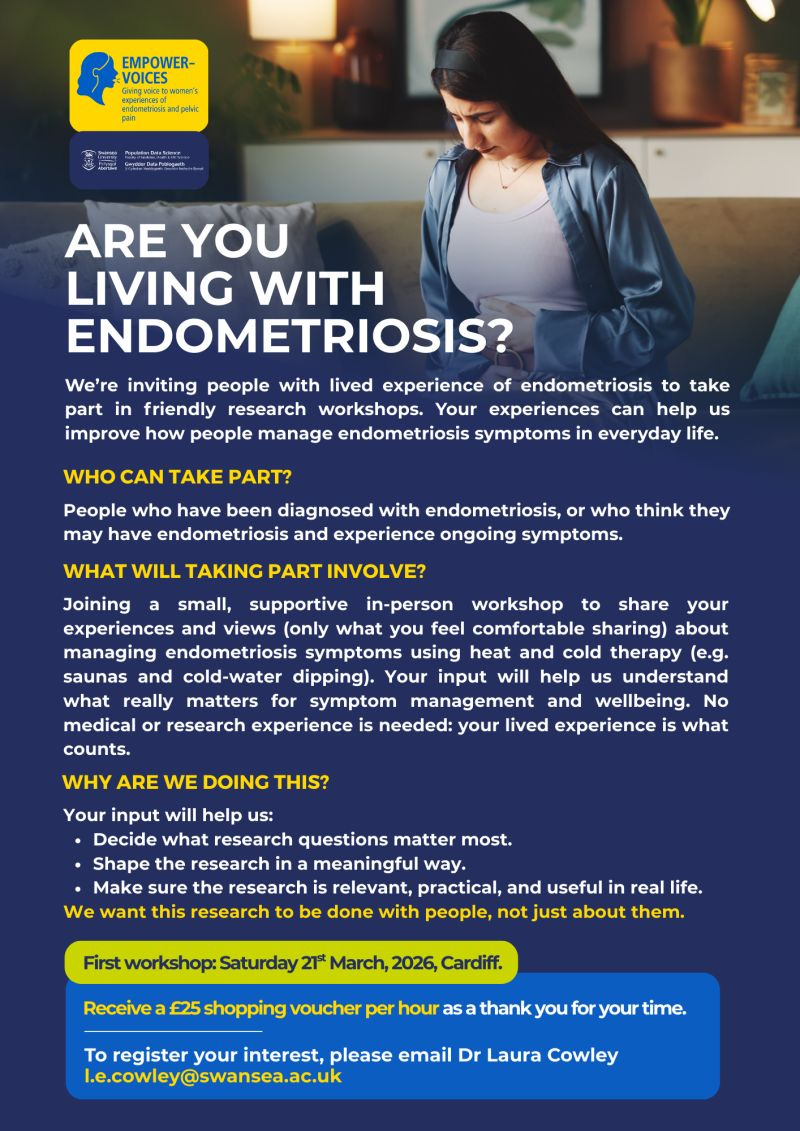
For Welsh readers, Swansea University is recruiting people to join its Patient and Public Involvement panel to help shape upcoming endometriosis research projects. Participants will join a small, in-person group and share their experiences. Register your interest via l.e.cowley@swansea.ac.uk
Another critical ‘why’ question concerns treatment for hyperemesis gravidarum, or extreme pregnancy sickness. Anyone familiar with the condition will know how debilitating it can be. Treatments exist, but access in the UK remains inconsistent. Campaigners are asking why should women continue to suffer in this way.

For those who don’t know, when I’m not writing this newsletter or supporting founders with their messaging, I’m Head of Communications and Engagement at an NHS GP Federation.
I spend my working life sitting between patients, clinicians, researchers and health-tech teams, translating complexity, spotting gaps, and helping explain not just what the data says, but why it matters.
If you’re looking for support with brand or research communications from someone who understands the NHS from the inside, alongside the realities of women’s health and innovation, I’d be glad to help.
I’ll be increasing the price of my Communications Coaching Workshop next week. Anyone booking before then can do so at the current rate here.
Thanks very much for reading,
I totally agree - apps need to be prepared to handle those "in between" results and ensure that people receive appropriate preventative health education and support. If we aren't building this in, or ensuring triaging to traditional healthcare services, it's a huge opportunity missed. (ps. thanks for recording this as a podcast - I'm ill today and it's much easier to listen than read - it's something I need to do start doing on my substack too!)