
The most powerful words missing from women’s healthcare
The danger of certainty in under-researched medicine

Hello lovely reader,
It’s the unfortunate reality that dismissal and gaslighting is common place in women’s care. If asked when I’ve experienced it, I’ll often talk about my pregnancies and childbirth: the times when I felt almost vessel-like. But on reflection, it’s happened to to me countless times before that, too.
I trace mine back to my ongoing acne battles. As a teenager, my skin was something to be managed, medicated and quietly endured. Like countless girls, I was prescribed the contraceptive pill, not for contraception, but to keep my face ‘under control’. It was presented as a solution, not a stopgap.
In my twenties, when I came off the pill and finally asked for answers, I was referred to a dermatologist. The appointment lasted minutes. My acne was dismissed as minor. I was advised, flippantly, to stop eating peanut butter as though perhaps everything may have been caused by what I was putting on my toast. What I wasn’t given was an explanation as to why this was happening to me. Because there wasn’t one.
This is a familiar pattern in women’s health. When the evidence is thin, certainty is often performed rather than admitted. Symptoms are minimised, questions deflected and responsibility subtly shifted back onto the patient.
The result is not just frustration, but mistrust. Years of being told that nothing is wrong, or that the problem lies with lifestyle, weight or attitude, have created fertile ground for misinformation to thrive.
Dr Angela Wright recently shared this thinking over on LinkedIn. She said: “I long for a culture that encourages our experts to feel ok to say: “we don’t know yet” or “I’m not sure, but I can try and find out for you.”
In women’s health, there is power in saying “I don’t know”. Not as an abdication of responsibility, but as an honest reflection of decades of under-research.
Until we normalise that honesty, women will continue to look elsewhere for answers. And it is hardly surprising that misinformation fills the void.
If you feel dismissed in a clinical setting, here are a few practical ways to respond:
Ask whether the guidance you are being given is based on clinical evidence or personal experience. It is a gentle way to establish whether the research is truly there.
If possible, book appointments with a GP who has a women’s health specialism. Most practices have one. You may need to wait longer, so this is not always appropriate for urgent issues, but it is a helpful default where you can.
Remember that healthcare professionals are human too. Many are navigating the same gaps in knowledge. Your lived experience matters, and it deserves to be taken seriously.

Research to know about this week
This week’s research sits right at that uncomfortable intersection between lived experience and what medicine is still trying to catch up with.
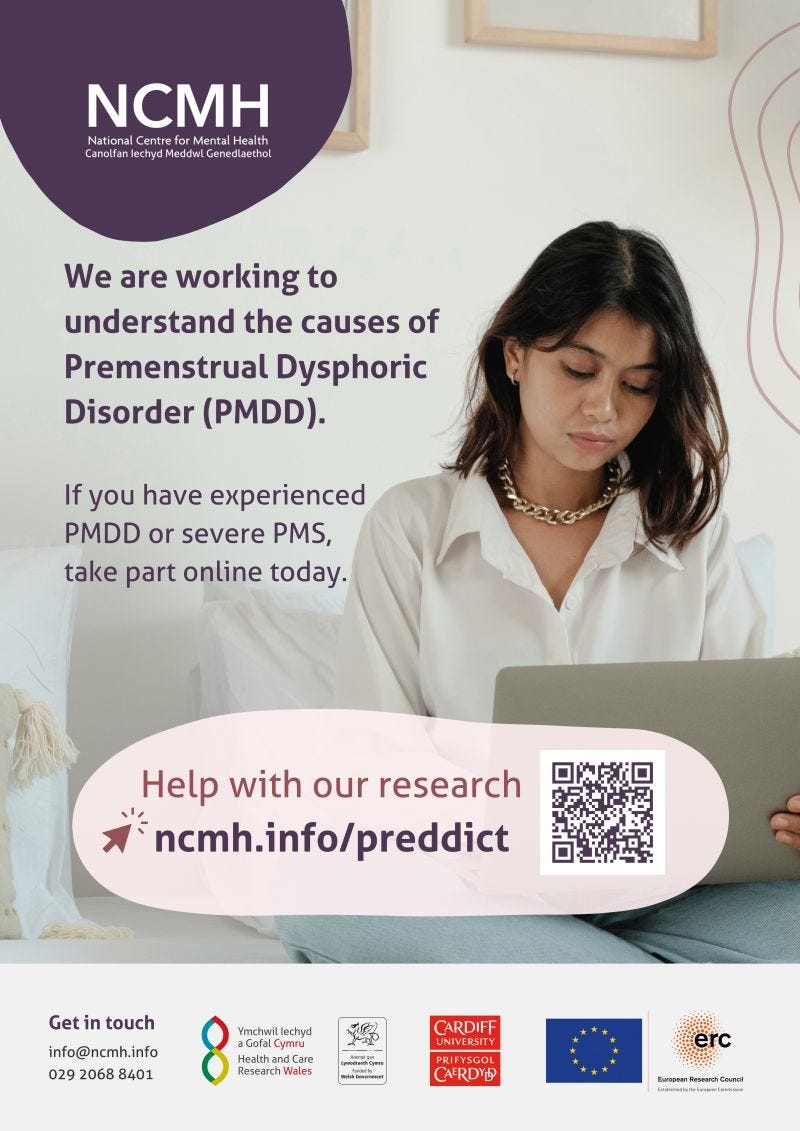
Researchers from Durham University are exploring how Premenstrual Dysphoric Disorder (PMDD) impacts cognition. This study consists of two surveys and three cognitive tests and should take no longer than 1 hour to complete. They’re looking for people with and without PMDD to take part here.
Another PMDD study is happening over at the National Centre for Maternal Health at Cardiff University. The PreDDICT Project is looking at whether individual’s genes and environment can help identify those at risk of psychiatric disorders associated with reproductive events, such as the menstrual cycle. Get involved here.
Finally, a development that deserves far more attention. The World Health Organization is working with researchers and drug developers to find ways to safely include pregnant women in clinical trials. The Independent explains why this matters, and why exclusion has come at a cost.

To finish, a quick reminder that I offer communications consultancy to women’s health brands and researchers.
This month, I’m working with a brand that recently won at the JP Morgan Healthcare Conference, helping them refine their messaging as their market position evolves. In February, I have capacity to support two organisations with brand messaging work. You can find out more here.
Thanks very much for reading,
This definitely resonates (as a former doctor) – there is so much power in a transparent and honest conversation between medical professionals and patients – it's ok to be human and to explore the unknown together. Hopefully FemTech will help to empower women in these conversations. Thanks for sharing.
100% this 'Your lived experience matters, and it deserves to be taken seriously.' We know our bodies and we know when there's something wrong. Thank you for naming it.